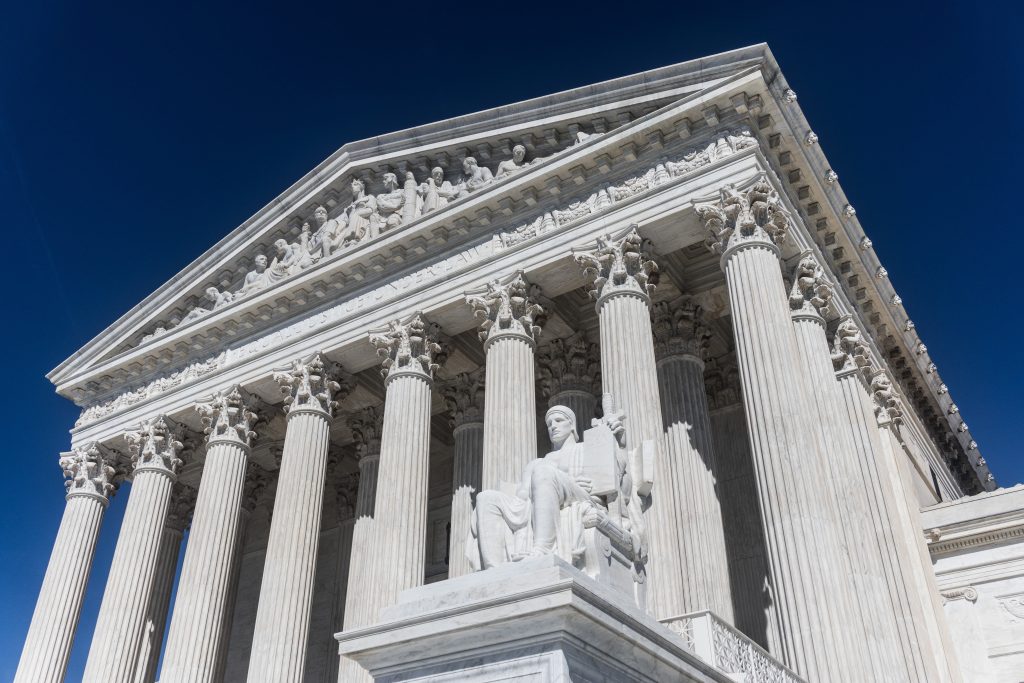
(Oregon Right to Life) — The U.S. Supreme Court on Thursday issued an order permitting the distribution of dangerous abortion pills through the mail amid an ongoing lawsuit against the U.S. FDA. The move comes after a federal appellate court issued a unanimous ruling earlier this month that – if allowed to take effect – would have blocked mail-order abortion nationwide.
In the apparent 7-2 order issued Thursday evening, the U.S. Supreme Court granted a request from Danco and GenBioPro, companies that produce the abortion pill mifepristone and its generic alternative. The corporations had asked the Court for “emergency” relief from the Fifth Circuit Court of Appeals’ unanimous May 1 decision that would have effectively reinstated the in-person dispensing requirement for the abortion drug earlier this month.
Justices Samuel Alito and Clarence Thomas wrote separate dissenting opinions, with Thomas blasting the drug manufacturers as operators of a “criminal enterprise,” and Alito arguing that “[w]hat is at stake is the perpetration of a scheme to undermine our decision in Dobbs v. Jackson Women’s Health Organization, which restored the right of each state to decide how to regulate abortions within its borders.”
The Supreme Court issued its order despite numerous amicus briefs, including those by 23 states and over 100 lawmakers, urging the Court to uphold the Fifth Circuit’s ruling.
READ: 23 States, Over 100 Lawmakers Call on U.S. Supreme Court to Block Mail-Order Abortion Pills
Thursday’s decision will allow the continued distribution of abortion pills through the mail while a lawsuit brought by the state of Louisiana against the FDA continues. Louisiana is seeking to push the FDA to restore regulations on mifepristone, which were removed in 2023 under the Biden administration. The May 1 decision by the appellate court found that Louisiana’s lawsuit was likely to succeed; however, the litigation has not yet concluded. It is likely that the legal challenge will continue into next year and potentially beyond, the Associated Press reported.
Pro-life organizations have responded with dismay to the Supreme Court’s order, noting that women and unborn babies will continue to be harmed.
“The order today from the U.S. Supreme Court means that unborn babies – even in states with pro-life laws – will continue to be subjected to lethal violence, and their mothers will continue to face risks of coercion, serious injury, and even death,” Anderson said in a statement. “The Supreme Court’s order in favor of the manufacturers of these drugs is a major disappointment. It is a shame that our nation’s highest court chose to protect what Justice Clarence Thomas correctly called in his dissenting opinion a ‘criminal enterprise.’”
“This decision is deeply troubling because it leaves women exposed to powerful abortion drugs,” Carol Tobias, president of National Right to Life, said in a Thursday press release. “Women facing unexpected pregnancies deserve real medical care and support, not a one-size-fits-all mail-order abortion system that minimizes risks and leaves women isolated during medical emergencies.”
“This decision will result in the deaths of countless preborn babies and puts women’s health at risk,” the pro-life organization Live Action said in a social media post.
The U.S. Supreme Court’s order comes after the FDA initiated a safety review of mifepristone following a 2025 study finding the adverse reaction rate associated with the drug to be over one in ten (10.93%), twenty-two times the rate currently listed on its official FDA label. However, the safety review, initiated under HHS Commissioner Marty Makary has not yet been concluded. Makary stepped down from his role this week.
Federal regulations and safeguards on abortion drugs have been severely eroded over the past decade. In 2016, the FDA expanded the timeframe in which mifepristone could be prescribed during pregnancy and removed the requirement to report complications that do not result in death. In 2023, the FDA revised the Risk Evaluation and Mitigation Strategy (REMS) for mifepristone, permitting the online prescription of the drug and its distribution through the mail. Local pharmacies were then authorized to dispense the drugs. That permission was also extended to retail pharmacies, including Walgreens and CVS.
Pro-life advocates have long raised the alarm that – in addition to their intended lethality for the unborn – the ready availability of abortion drugs poses serious risks of adverse events and undercuts state laws protecting unborn lives.
Without a required ultrasound, women and girls may be incorrectly prescribed abortion pills even if they have a later or ectopic pregnancy, placing them at risk of serious side effects or even death. Online prescription and distribution through the mail further increases the risk that bad actors may obtain the pills to carry out forced abortions. Meanwhile, distribution of abortion drugs through the mail undermines state laws that ban or limit abortion, despite the U.S. Supreme Court’s ruling in Dobbs v. Jackson (2022) that the right to regulate abortion is to be determined by the people and their elected representatives.