
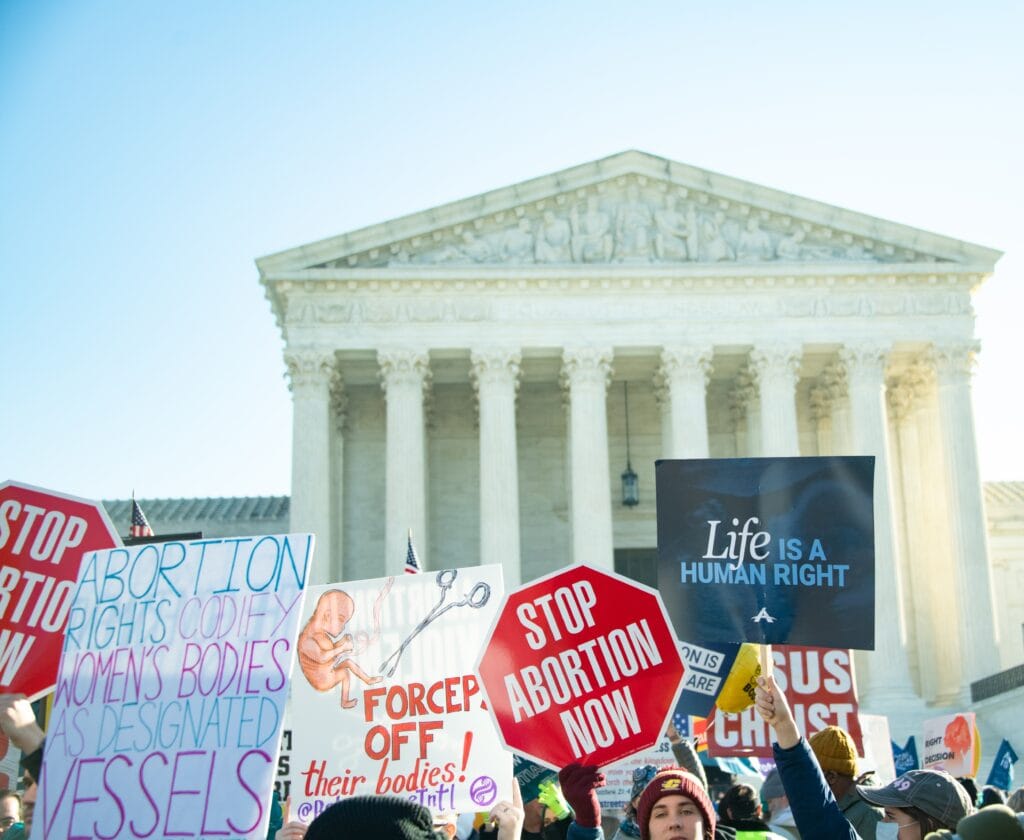
(Oregon Right to Life) — January 22nd, 2026, marks 53 years since the U.S. Supreme Court created a constitutional “right” to abortion in Roe v. Wade. Though the Court overturned Roe in 2022, pro-life advocates continue to recall the history of the landmark decision that led to the abortions of tens of millions of unborn babies nationwide over nearly five decades.
On January 22nd, 1973, the U.S. Supreme Court handed down its ruling in Roe v. Wade, a decision that forced states to allow abortion within their borders. The Court laid out a three-trimester understanding of pregnancy for legal purposes, with abortions to be permitted for any reason in the first trimester and limitations possible in the second and third trimesters.
In Doe v. Bolton, however – decided the same day as Roe – the Supreme Court provided a broad definition of “health of the mother” criteria under which states must allow abortions regardless of the unborn baby’s gestational age. In Doe, Supreme Court Justice Harry Blackmun wrote that an abortion provider’s medical judgment may be “exercised in the light of all factors—physical, emotional, psychological, familial, and the woman’s age-relevant to the wellbeing of the patient. All of these factors may relate to health.”
In practice, Blackmun’s “health of the mother” definition effectively forced states to allow abortions throughout pregnancy for any reason that an abortion provider would agree to.
In the aftermath of Roe v. Wade, hundreds of thousands of abortions were legally performed every year. States that attempted to pass laws limiting abortions or protecting unborn lives saw their laws rejected by the nation’s highest Court, in keeping with Roe and Doe.
Decades later, in Planned Parenthood v. Casey (1992), the Supreme Court reaffirmed Roe but somewhat loosened restrictions on states passing pro-life legislation, authorizing state limits on abortion that did not place “an undue burden” on the right to abortion invented in Roe.
READ: Abortion History in America
It wasn’t until 2022 that Roe’s grip on American law concerning abortion would finally be pried away.
After decades of united pro-life action – from the National March for Life in Washington, D.C., to the efforts of national and local pro-life organizations like Oregon Right to Life, National Right to Life, Susan B. Anthony Pro-Life America, Live Action, and many more – the U.S. Supreme Court agreed to hear a case concerning Missouri’s 2018 law prohibiting nearly all abortions after 15 weeks gestation.
The case, Dobbs v. Jackson Women’s Health Organization, was decided in June 2022. In it, the U.S. Supreme Court not only ruled that Missouri’s law was constitutional – but that Roe v. Wade and Planned Parenthood v. Casey were not constitutional. In Dobbs, the Court ruled that “[T]he Constitution does not confer a right to abortion; Roe and Casey are overruled; and the authority to regulate abortion is returned to the people and their elected representatives.”
Pro-life advocates nationwide celebrated the rollback of Roe after almost half a century of nearly unfettered legal abortion. Thanks to Dobbs, states could once again pass laws protecting unborn life. Many states with pro-life leadership immediately enacted pro-life protections, with some passing laws limiting abortion at particular gestational ages and others prohibiting the practice outright with narrow exceptions.
But other states doubled down, approving radical abortion ballot measures and using the legislature to expand abortion access and funding. States like Oregon, Colorado, and New York even encouraged women to engage in abortion tourism: traveling from pro-life states to obtain abortions.
As Oregon Right to Life has reported, Malheur County in Eastern Oregon – which directly borders Idaho – has been targeted by Planned Parenthood for abortion tourism due to Oregon’s lack of restrictions on abortion in contrast to the pro-life protections in neighboring Idaho. Malheur County subsequently reported over 1,300 abortions in just two years – the vast majority of which were for women who did not reside in Oregon. The county had zero annual abortions prior to 2023. Oregon Right to Life has responded by directing substantial resources to supporting access to life-affirming resources and education in Eastern Oregon.
At the state and national level, pro-life advocates continue to work to enshrine more robust protections for unborn babies, so that the right to life is not dependent upon what state an unborn human being’s mother resides in or travels to.
Many decisions made by the second Trump administration have supported efforts to protect the unborn, including the 2025 federal defunding of Planned Parenthood for a year; the agreement to investigate safety claims concerning the abortion pill mifepristone; and the cessation of taxpayer funding for abortions overseas.
On January 23rd, 2026, tens of thousands of pro-life advocates are expected to attend the annual March for Life in Washington, D.C. on the National Mall. U.S. Vice President J.D. Vance is scheduled to speak at the event.