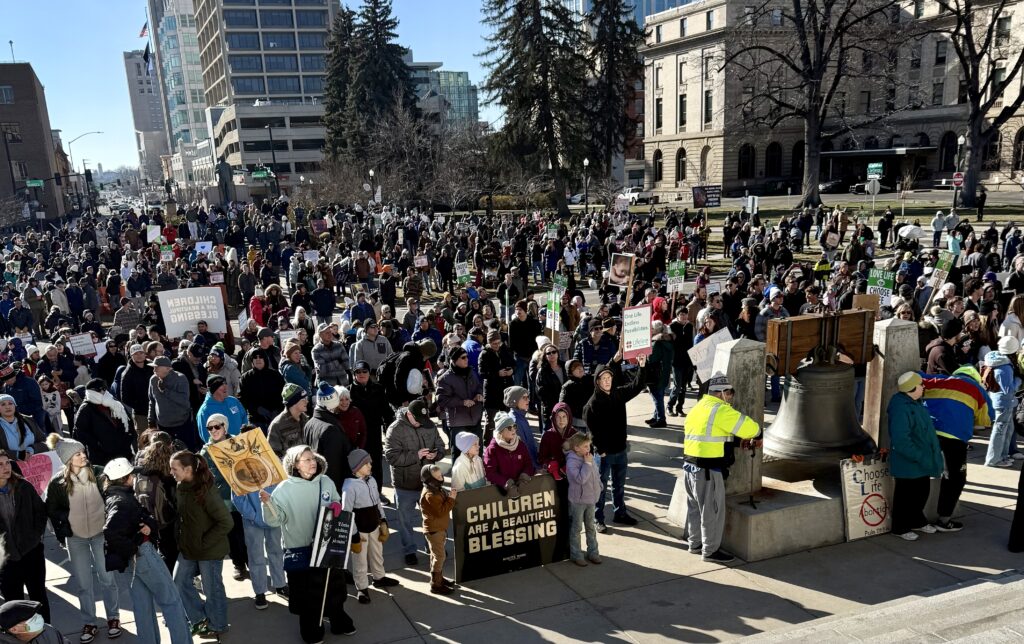
(Oregon Right to Life) — Thousands of pro-life Idahoans took to the streets in peaceful advocacy late last month for the state’s annual March for Life in Boise. The event came as Idaho prepares to face a dangerous ballot initiative that could undo its strong pro-life laws.
The Boise March for Life – put on by Right to Life of Idaho – started at Julia Davis Park on Saturday, January 24, and ended with a rally on the steps of the Idaho State Capitol building. An estimated 2,500 or more people participated in the March.
Matt Britton, Esq, General Counsel and Board ex-officio for 40 Days for Life Institute for Law and Justice, gave the keynote address. Additional speakers included Right to Life of Idaho President Emily Naugle, Bishop Peter of the Roman Catholic Diocese of Boise, and Pastor David Ax of Calvary Chapel Star, among others.
RELATED: Idaho Hospital Near Oregon Border Set to Install Life-Saving ‘Safe Haven Baby Box’
“There was a sense of pride in the laws we have protecting life but also budding momentum as Idaho prepares to fight for their lives like never before with an impending ballot initiative to be seen in November 2026,” Naugle told Oregon Right to Life in a Monday text message. “Idaho’s prolife movement needs unity to succeed in this uphill fight. We need all our pro-life base to win!”
A statement published on the Right to Life of Idaho website noted that this year will be a difficult one for Idaho, as the state faces a ballot measure that would “undermine our pro-life laws.”
Current Idaho law prohibits abortion under nearly all circumstances, protecting unborn lives with narrow exceptions. But a pro-abortion ballot measure that could land on Idaho’s November 3, 2026 ballot as an initiated state statute would enshrine a “right” to abortion in the Gem State’s constitution.
“[T]he referendum could take our laws from some of the most protective in the entire country to allowing abortion up to viability and in some cases beyond,” Naugle said. “Prayers are appreciated as we are exactly [nine months] away from the November vote.”
Dubbed the “Idaho Reproductive Freedom and Privacy Act Initiative,” the initiative would establish that “[e]very person has the right to reproductive freedom and privacy, which entails the right to make and carry out one’s own reproductive decisions, including but not limited to decisions on: pregnancy; contraception; fertility treatment; prenatal and postpartum care; childbirth; continuing one’s own pregnancy; miscarriage care; and, abortion care [sic].”
So far, most states that have seen the introduction of ballot measures similar to Idaho’s have ended up enshrining abortion into their state constitutions – from predictably left-wing states like Colorado and New York to more conservative states like Ohio and Montana. However, last year voters rejected similar initiatives in Florida, Nebraska, and South Dakota, providing proof that pro-life advocates can defeat such measures.
“Where many states have failed we hope Idaho will end in the winner’s circle,” Naugle said.
RELATED: Idaho Woman Reunites with Birth Mom Who Bravely Chose Life
Idahoans and interested Oregonians can find information about the ballot measure on Right to Life Idaho’s website, including a video statement by an attorney dispelling pro-abortion myths about the state’s existing pro-life legal protections – including the false claim that women are unable to receive care for ectopic pregnancies and miscarriages under the state’s existing laws.
As Oregon Right to Life has extensively reported, Eastern Oregon near Idaho has become a destination for abortion tourism since Idaho passed its pro-life legislation following the overturning of Roe v. Wade, prompting dedicated pro-life attention to the region to ensure that women and girls know they have life-affirming options. An Oregon Right to Life pro-life resource guide for the area is slated to be published this spring.
To learn more about pro-life advocacy in Eastern Oregon, visit ortl.org/easternoregon.
Oregon’s annual March for Life will take place this year on May 30th. Formerly held in January, the event was moved to May following the overturning of Roe v. Wade to mark when Oregon passed its state law legalizing abortion in May, 1969.